


Marc Pritchard, Chief Brand Officer of P&G, structured his Cannes session as a duel. For each big question on the audience's mind, he first read out a tidy answer from a P&G AI engine he nicknamed "ChatPG," then countered with the version only decades of human experience produce. The format made his argument before he did: AI can accelerate almost everything about modern brand building except the part that matters most, the human insight at its core. His closing line was the thesis in miniature. Robots don't build brands, people do.
Three Shifts Colliding
Pritchard framed the moment as three forces in perpetual motion. The first is media and content fragmentation, a jump from newspapers, radio and TV to an exponential sprawl of social, streaming, search, large language models and generative AI. The second is media and commerce convergence, where a consumer can see a brand on their phone and have it delivered in minutes, already a reality with Alibaba in China and quick-commerce in India. The third is the AI turbocharge, which speeds up the first two and lets consumers pull personalized, curated experiences from every source they choose. Together, he argued, these are tectonic shifts pushing brand building onto a new S-curve.
What Stays the Same: the Fairy Insight
His sharpest point was about what does not change. The fundamentals still hold: a relevant human insight leads to a meaningful brand idea, which comes to life as a brand experience at a price worth paying, and brands still grow by building awareness and memory.
He illustrated it with a mistake. P&G's US dish brand Dawn Powerwash lets people spray, wipe and skip the soaking, and it worked so well the team assumed it would travel. Taken to the UK, it was rejected outright. The reason was cultural: in the UK, leaving dishes to soak is a small ritual, a way of reassuring yourself they will actually come clean. That insight produced a better local idea for the Fairy brand, "skip the soak," which respected the habit instead of fighting it and delivered double-digit growth. AI, he noted, could have analyzed millions of dishwashing sessions and still missed the deeply human ritual behind them. That kind of observation, empathy and intuition is what a model cannot originate.
The Three Voices, All of Them Human
Pritchard broke brand communication into three voices and stressed that each is fundamentally human. The brand voice carries the brand's point of view and runs on a human insight turned into a creative idea. The expert voice, from influencers, creators, professionals and affiliates, runs on human credibility, because those people could talk about any brand and chose yours. The consumer voice, user-generated content from people moved enough to talk about a product, is the most genuine of all, because shoppers trust other shoppers more than anyone. AI can amplify all three, he said, but it does not originate them.
Old Spice was his example of all three working together. Built on the very human insight that every man wants to smell like a man, the brand's long-running, absurd films supply the brand voice, paid actors and creators supply the expert voice, and fans supply the consumer voice. He pointed to a recent cereal tie-in that took off largely on organic reaction, with very little paid support, as proof of how far that can travel now.
What Changes: the Work Gets Faster, by a Lot
If the fundamentals hold, the way teams work has been rewired. Pritchard contrasted the old sequential process, focus groups, storyboards, rounds of revisions, a single big test, then a media flight to reach most people a few times a month, which could take the better part of a year, with a new continuous flow of insight, creation and execution measured in hours and days.
Secret deodorant was his proof point. An in-house content team, working in person and aided by AI, uncovered a human truth that anyone at the festival would recognize: stress sweat smells the worst, others often notice it before you do, and realizing that stresses you out further. From that came the idea "Under Pressure," with a performance promise that the product works hardest when you do. The team used generative tools to prototype, test and produce, scaling social assets roughly tenfold, and reported double-digit commerce growth and a brand lift of around 8%.
He cited Tide Evo, billed as P&G's biggest laundry launch in decades, as a case where the team chased a "real laundry magic" idea through human creativity before AI helped scale it, and a Pantene Europe sun-protection-for-hair launch that went from insight to a full set of assets across Europe in about two months rather than a year and a half, by his account roughly five times faster and five times cheaper.
When to Use Less AI: SK-II
Notably, Pritchard's case was not that more AI is always better. He pointed to SK-II, which had drifted from its essence, returning to the human truth at the brand's heart and deliberately rejecting AI-generated imagery in favor of real "living proof" of more youthful skin. The brand returned to double-digit growth. The lesson he drew was that knowing when not to reach for the tool is itself a creative judgment.
Measurement: Watch the Sales, Not the Dashboard
On the perennial ROI question, Pritchard leaned on commerce convergence. As media and retail media merge, he argued, retail sales become a clearer signal of what works than what he called dubious measurement, freeing teams to use common sense: try something and watch the sales response.
Mr. Clean was the example. The 68-year-old icon "retired" in a campaign that played out as a cultural stunt, drew speculation, and brought him back in a new era tied to a more durable Magic Eraser.
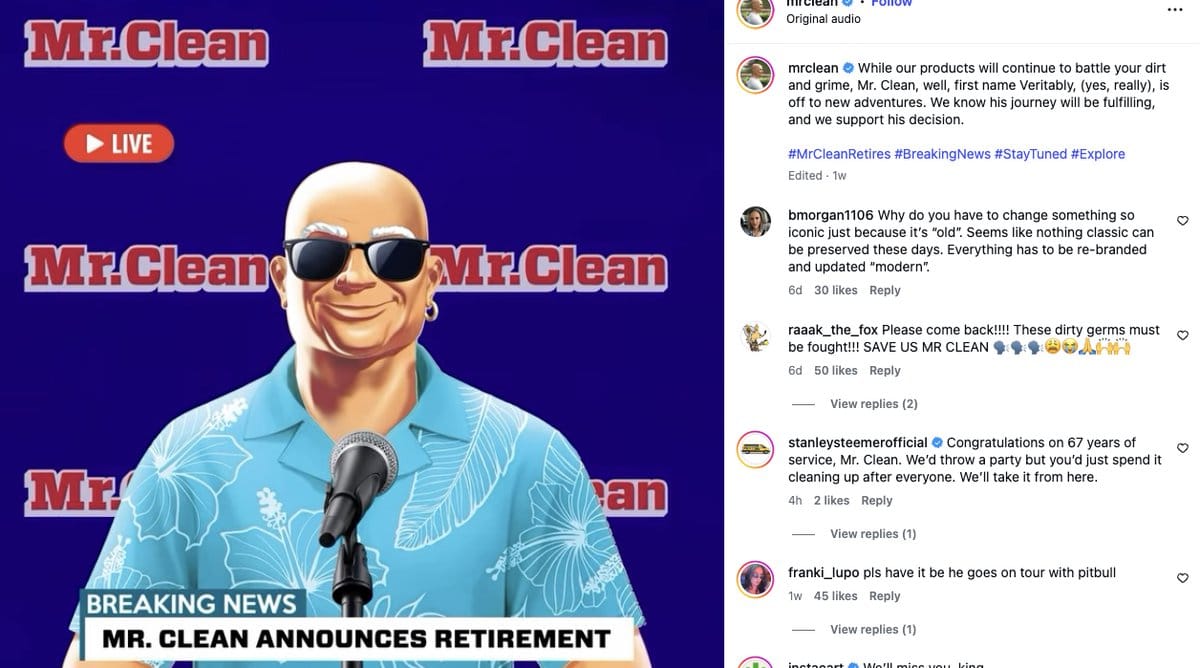
It ran on very little paid media and mostly earned social attention, and Pritchard reported visual-counter sales up around 50% and strong total-brand growth, with human judgment, not a complicated attribution model, telling the team it was working.
Three Ideas to Take Away
- The fundamentals don't move; the workflow does. Human insight to brand idea to experience still wins, but the cycle now runs in hours, with far more volume and variety.
- The voices that matter are human. Brand, expert and consumer voices can be amplified by AI but not originated by it, which is why authenticity still travels furthest.
- Use AI as a turbocharger, and know when to switch it off. Secret and Pantene show the speed, SK-II shows the discipline of choosing real over generated when the brand calls for it.