


Demis Hassabis, co-founder and CEO of Google DeepMind, took the Cannes stage to talk about where artificial intelligence is actually heading, and his answer ran against the grain of a festival built on advertising. AI is somewhat overhyped in the near term, he argued, and underrated over the long run, with its biggest payoff in science and discovery rather than marketing. He was careful with timelines and clear about what is still missing before machines reach anything like general intelligence.
What's Still Missing for AGI
Hassabis defined AGI the way DeepMind has since 2010: a system that exhibits all the cognitive capabilities humans have, with the human brain as the only existence proof of general intelligence we have. He framed the question through Alan Turing and the limits of computation, the boundary of what a machine can actually calculate.
Two capabilities, he said, are still missing. The first is long-term reasoning. The second is genuine creativity, by which he meant inventing a truly novel idea rather than interpolating between known ones. In science, that would look like proposing a new hypothesis, not recombining existing ones. He declined to put a hard date on AGI, presenting "it's close" as his own view rather than a settled fact.
From Video Games to Frontier Models
Hassabis traced his start in AI to programming video games in the 1990s, where AI was a core component rather than a bolt-on feature. He pointed to his simulation work on the 1994 game Theme Park, where the system reacted to how each person played and gave players a different experience based on their choices. Watching millions of people interact with that adaptive AI, he said, set the direction for a career spent building intelligent systems.
That history shaped how he described DeepMind's Cannes recognition this year: a project that uses AI to generate not just content but interactive experiences, which he tied back again to game design.
The Real Prize Is Science
Asked where AI matters most, Hassabis kept returning to science. His personal focus is applying AI to research, and he pointed to DeepMind's work on protein structure and to Isomorphic Labs, the company building AI to help discover new drugs. Creativity, he argued, is part of what separates great scientists from merely good ones, and his bet is that these tools will assist scientists rather than replace that judgment.
On safety, he was direct about the dual-use problem. The same general-purpose systems that can advance medicine and science can also be misused, including by cyber attackers. One defensive approach he described is leading labs running their own AI coding agents continuously to find and fix vulnerabilities before others can exploit them.
How AI Is Changing DeepMind's Own Work
Hassabis said AI is already accelerating how the company codes and researches, with product teams building on each new model as its capabilities land and iteration moving faster as a result. On his own routine, he splits the day between meetings in the London office and late nights spent on research. He also made a practical wish that many in the audience would recognize: he wants AI to handle his email reliably, going beyond today's summaries toward systems that can eventually act on your behalf.
When asked what creative tool he would most like to see, he described multimodal generative models that are not only high quality but editable, so a creator can adjust an image or scene through natural language rather than starting over. The reason the best image models work, he said, is an underlying grasp of language and a degree of world understanding, so an instruction like moving an object behind a set is understood in context rather than treated as pixels alone.
Creativity, Control, and the Sphere
On storytelling, Hassabis located the open problem not in raw capability but in control. Creators making quick social ads may happily give up some control, but serious artists will not, and the question is what new workflows can fold in these tools while preserving precision and authorship.
His clearest example was the reworking of The Wizard of Oz for the Sphere in Las Vegas.
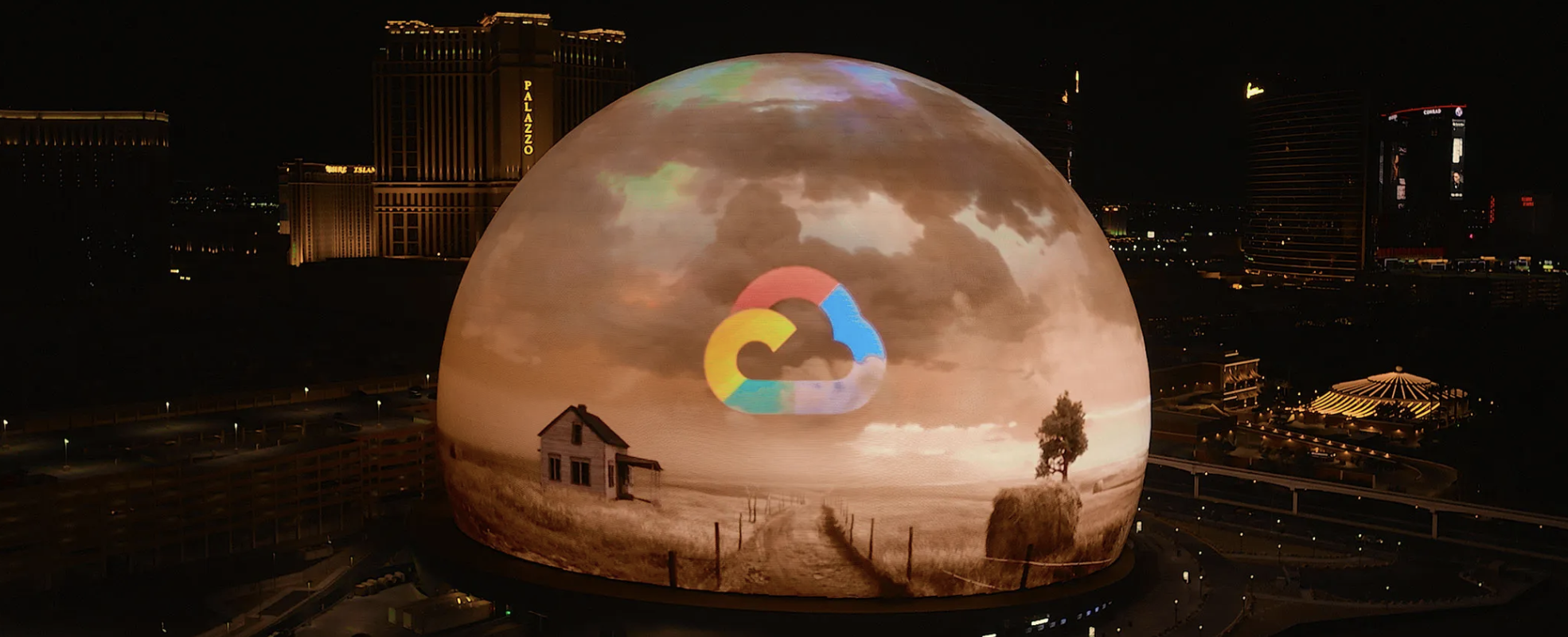
To fill that enormous screen, the team used a mix of specialized and general models to expand the original footage well beyond its native frame, a task he suggested would have been close to impossible otherwise. He described the result as immersive enough that you feel like you are inside the storm, and noted it has drawn strong audiences. On architecture, he expected a near-term mix of specialized models strong at specific tasks like voice or video, converging over time toward systems that do many things well.
Three Ideas to Take Away
- The frontier gaps are reasoning and real novelty. Hassabis put long-term reasoning and genuinely new ideas, not interpolation, at the top of the AGI to-do list.
- Science is the application he cares about most. Protein-structure work and Isomorphic Labs were his go-to examples of AI as a tool for discovery.
- In creative work, control is the bottleneck. The challenge is less capability than building workflows that let artists keep precision and authorship, with the Sphere's Wizard of Oz as a concrete proof point.